
Company Background
This enterprise HR software company, founded in 2016, has grown into one of the fastest-scaling players in the HR technology market. With 2,000+ customers, a team of 1,000-5,000 employees, and approximately $300M in annual revenue, the company offers a comprehensive suite of 10+ products spanning payroll processing, benefits administration, talent management, workforce analytics, and compliance tools. Their platform serves businesses from mid-market through enterprise, with buying committees that include HR directors, CHROs, CFOs, IT leaders, and benefits administrators, 15+ distinct buyer personas in total.
The company's rapid growth created both opportunity and complexity on the go-to-market side. With a massive total addressable market and a multi-product platform, the potential for cross-sell, upsell, and new logo acquisition was enormous. But realizing that potential required personalized outreach at a scale that their existing team and processes could not support.
The Challenge
Despite having hundreds of thousands of intent-qualified leads in their pipeline, contacts who had engaged with content, attended webinars, or been scored as high-intent by their marketing automation platform, the company lacked efficient methods to personalize outreach at the scale required. Four interconnected problems were compounding to create a widening gap between pipeline potential and pipeline reality.
Template fatigue was killing engagement rates. The company's outreach relied on templated emails with basic variable substitution, first name, company name, and occasionally job title. These emails looked like what they were: mass-produced templates. Prospects, especially HR leaders who receive dozens of vendor emails weekly, could immediately identify and ignore them. Open rates were declining quarter over quarter, and reply rates had plateaued at levels well below what the team needed to hit growth targets.
Product complexity made manual personalization nearly impossible. With 10+ products serving 15+ buyer personas, the challenge was not just personalizing the opening line, it was matching the right product value proposition to the right prospect. An email to a CHRO evaluating talent management solutions needed a fundamentally different message than an email to a CFO evaluating payroll optimization. Manually determining the right product angle for each prospect, researching their specific context, and writing a relevant email was a task that even experienced reps struggled with. New reps found it overwhelming.
A massive backlog of qualified leads sat dormant. The company had accumulated over 500,000 leads that were qualified based on intent signals but had never been contacted with personalized outreach. The team simply could not personalize fast enough to work through the backlog while also handling inbound and ongoing prospecting. Every week, more leads entered the pipeline than the team could process, and the gap continued to grow. These were not cold contacts, they were prospects who had demonstrated interest and were slowly aging out of the buying window.
SDR productivity was bottlenecked by research and writing. Each rep spent 15-20 minutes per prospect on the research-to-send workflow: identifying the right product angle, researching the prospect's company and role, crafting a personalized message, and loading it into Outreach. At that pace, a full-time SDR could personalize and send approximately 20-25 emails per day, far below the volume needed to make a dent in a pipeline of hundreds of thousands of contacts.
Why Autobound
The company's revenue operations team evaluated building an in-house solution, using generic AI writing tools, and partnering with specialized vendors. They selected Autobound for three reasons.
First, Autobound's Generate Insights API could be integrated directly into their Salesforce workflow, enabling a fully automated pipeline from lead scoring to personalized email delivery without manual intervention. This was critical for the growth marketing use case where the goal was to process thousands of leads daily without human involvement in the content creation step.
Second, Autobound's Insights Engine provided the depth of prospect research needed to match the right product message to the right buyer persona. Rather than generic personalization, Autobound could surface specific signals, a company's recent benefits expansion, a new CHRO hire, a compliance audit, a workforce reduction, and connect those signals to the relevant product in the company's portfolio. This persona-matching capability was something no other vendor could deliver at the required scale.
Third, the cost comparison was decisive. An internal estimate for building equivalent functionality came in at over $500,000 annually in data licensing, engineering resources, and ongoing maintenance. Autobound delivered the same capability at a fraction of that cost, with a faster time to production.
The Solution
The company deployed Autobound across two parallel use cases, each addressing a different part of their go-to-market challenge.
Growth Marketing (API Integration)
Autobound's API was integrated directly into the company's Salesforce instance, creating a fully automated content generation pipeline. When a lead reaches a qualifying score in their marketing automation platform, it is automatically passed to Autobound's Generate Insights API. The API returns comprehensive prospect and company research, pulling from 35+ data sources including financial filings, hiring activity, technology stack, recent news, and social signals, along with a personalized email draft matched to the appropriate product and buyer persona.
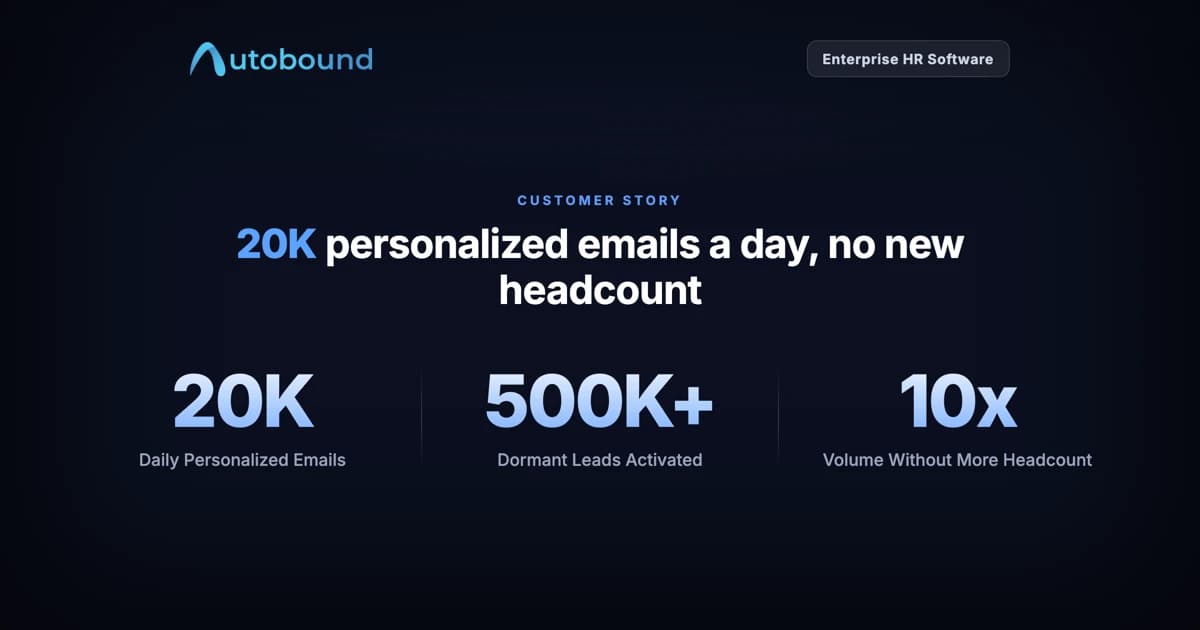
The generated content is then automatically loaded into Outreach sequences for delivery. The entire process from lead qualification to personalized email in the prospect's inbox happens without manual intervention. This system processes and sends 20,000 personalized emails daily, a 4-10x increase from the 2,000-5,000 templated emails the team was sending previously.
SDR Team (Direct Integration)
For the SDR team handling higher-value accounts and inbound follow-ups, Autobound was integrated with Outreach to automate the research and drafting steps of the workflow. When a rep opens a prospect in their queue, Autobound has already surfaced the relevant insights and generated a personalized draft. The rep reviews, makes any adjustments, and sends, reducing per-prospect time from 15-20 minutes to under two minutes.
This integration also solved the onboarding challenge. New reps no longer needed months of product training to understand which value proposition to lead with for each persona. Autobound's persona-matching logic handled that automatically, allowing new hires to start producing quality outreach within their first week rather than their first quarter.
The Results
The impact was immediate and continued to compound as the team optimized their messaging frameworks and expanded the deployment.
| Metric | Impact |
|---|---|
| Daily Personalized Emails | 20,000 (up from 2,000-5,000) |
| SDR Activity Output | 20-40% higher per SDR |
| Lead Activation | 500,000+ dormant leads activated |
| Cost Savings | $500K+ annually vs. building in-house |
| Onboarding Time | 3-4 months reduced to under 30 days |
| Scale | 10x volume without additional headcount |
The most transformative result was the activation of 500,000+ dormant leads that had previously been sitting untouched in the pipeline. These were intent-qualified contacts, prospects who had engaged with the company's content, attended events, or been identified through buying signals, that the team simply did not have the capacity to reach with personalized messaging. Autobound's API automation made it possible to work through this backlog systematically, converting aged leads into active pipeline.
The 10x increase in email volume without additional headcount fundamentally changed the economics of the company's outbound motion. Previously, scaling outbound meant hiring more SDRs, which meant more salaries, more management overhead, more training time, and a longer ramp to productivity. With Autobound, the existing team could cover dramatically more ground, allowing the company to redirect hiring budget toward closing capacity rather than top-of-funnel prospecting.
The reduction in new rep onboarding time from 3-4 months to under 30 days was equally significant. In a company hiring dozens of SDRs per year, compressing the ramp period by 60-75% translated into months of additional productive selling time across the team, a compounding advantage that grew with every new hire.
What's Next
The company is expanding their Autobound deployment across three new initiatives. First, they are extending the API integration to power personalized re-engagement campaigns for churned customers, using Autobound's insights to identify timely reasons to reconnect. Second, they are piloting Autobound for their partner channel, generating co-branded outreach for channel partners who lack the resources to personalize at scale. Third, they are exploring using Autobound's signal data to inform product-led growth triggers, automatically reaching out to free-tier users when company-level buying signals suggest an enterprise upgrade opportunity.
Explore Related Products
More Signal Intelligence Wins
Skuid
Learn how Skuid saw an 18x ROI within 3 months of usage, reduced seller ramp time, and enabled sellers to write personalized emails 8.8x faster.
Techmagic
Techmagic saw a 150% increase in monthly meetings with Autobound, along with 18% more SQLs and 10x reduction in research time.
tab32
Learn how tab32 saw 25% higher engagement rates, saved 7 hours per rep each week, and ramped reps to full productivity 50% faster.
Get the same signal intelligence
Talk to our team about signal data for your use case.