
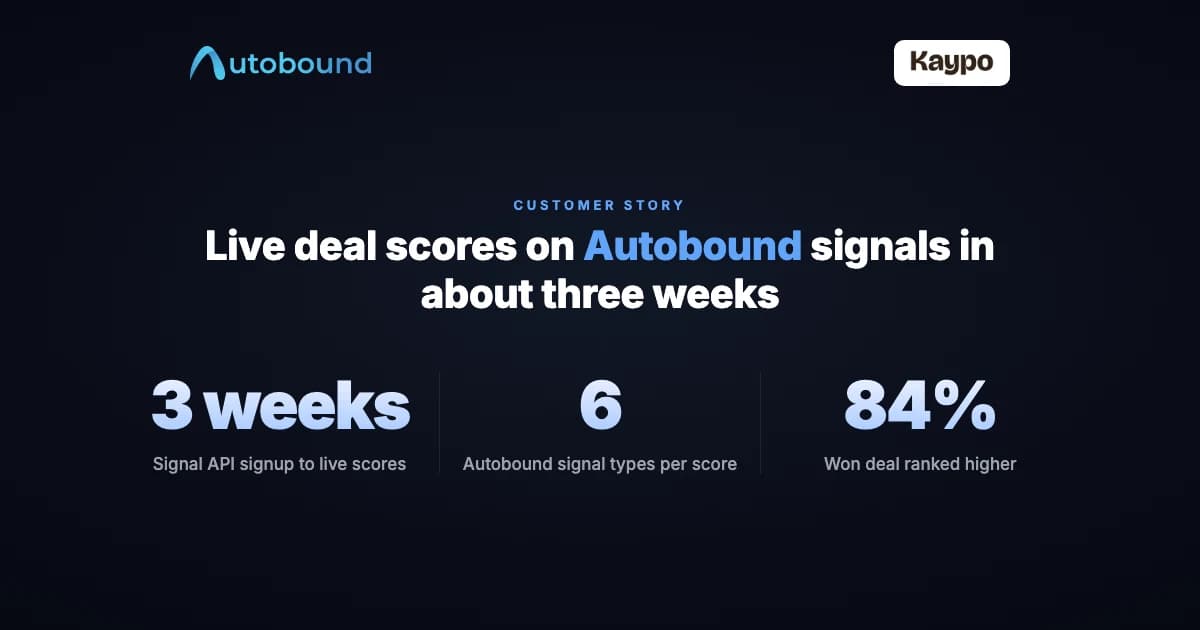
Kaypo: deal scoring built on how your team wins
Kaypo's founder, Daniel Stone, spent more than a decade in revenue operations and go-to-market before building Kaypo in Denver, Colorado.
A rep's "90%" isn't a forecast
In pipeline reviews, deals sat open with no follow-up, and forecasts rested on a rep calling a deal "90%" minutes before the meeting.
“In pipeline calls it's, 'Is this deal going to close? I've got to present this in 10 minutes.' 'Oh yeah, 90%.' In reality, there were six other deals left open that we found with the help of Autobound signals.”
Traditional deal scores only know what reps typed into the CRM, like the stage and the close date. Intent tools show which companies are researching a topic, but not which open deal it ties to, or whether it has ever mattered for that team. Kaypo combines the two.
“What I've found over the last five years is that a single signal simply isn't enough to get sales to go after a deal.”
Learning which signals matter for each team
Kaypo pulls a team's closed deals from the CRM and pairs each one with the Autobound signals on that account, like a new executive, a funding round or a hiring push. It then tests more than 3 million combinations of CRM activity and Autobound signals to find which ones showed up before wins.
“I love the idea of learning what signals suck. A lot of this stuff is irrelevant, and then you land on 'launched a product that's highly relevant to what our customer cares about.' Those are the ones that matter.”
Every morning, Kaypo scores open deals on the latest Autobound signals and CRM activity. Reps get a Slack message with the deals to work and the signal behind each one, like a new CFO at an account that just started researching forecasting software.
The same signals bring old deals back. When Autobound picks up new intent or a leadership change at a closed-lost account, Kaypo puts the deal back in front of the rep.
Outside facts across every industry
CRM history shows what a team did. Autobound shows what changed at the buyer: a new executive, a funding round, a hiring push, a surge in research on a relevant topic.
Because Kaypo's model spans 22 industries, it needed coverage that isn't tied to one vertical and reaches niche categories.
“We don't sit in just one industry, so we need that wider berth.”
Signal API to live scores in about three weeks
Kaypo pulls Autobound signals through the Signal API and feeds them straight into its scoring model alongside each team's CRM data. Buyer intent, news, hiring, funding, LinkedIn posts and job changes come in for every account in the pipeline, so each score reflects what changed at the buyer, not only what a rep typed in.
Illustrative example of Kaypo's morning Slack message, with the Autobound signals behind each deal:
84% of the time, the won deal ranks higher
Across 22 industries, when Kaypo compares a deal that was won with one that was lost, it ranks the won deal higher 84% of the time.
Autobound's signals feed every one of those scores. When a buyer hires a new executive, raises a round or starts researching a relevant topic, the deal's score moves, and the rep sees why in the next morning's Slack message.
“Where were you guys five years ago? For signal data, Autobound is the runaway best solution I've found.”
From open deals to the people behind them
- Contact-level signals, to show which person at an account is driving the activity.
- Testing more signal types from Autobound's 700+ catalog against past deals before they reach the live model.
- Weekly bulk intent exports as Kaypo scores more accounts.
“Scoring is the use case we hear about most from builders right now. Kaypo shows what happens when you weigh signals against a team's own wins instead of trusting any single one.”
Explore Related Products
More Signal Intelligence Wins

RocketReach
Learn how RocketReach added a timing layer to its 700M+ contact database by embedding Autobound's buying signals (funding rounds, leadership changes, hiring activity and more) into Person and Company Search.
Informa TechTarget (OEM)
Learn how Informa TechTarget increased user retention by 30% since launching IntentMail powered by Autobound's API.
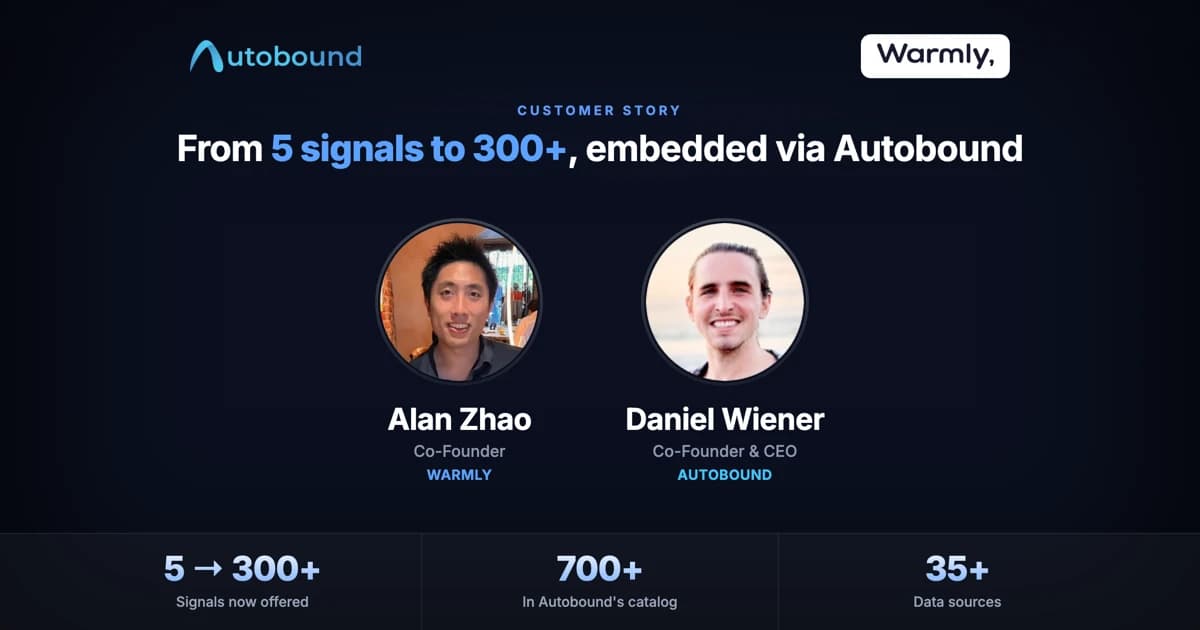
Warmly (OEM)
Learn how Warmly went from 5 signals to 300+ by embedding Autobound's full catalog into its API and MCP server, replacing a 2-year internal build with a single integration.
Get the same signal intelligence
Talk to our team about signal data for your use case.