
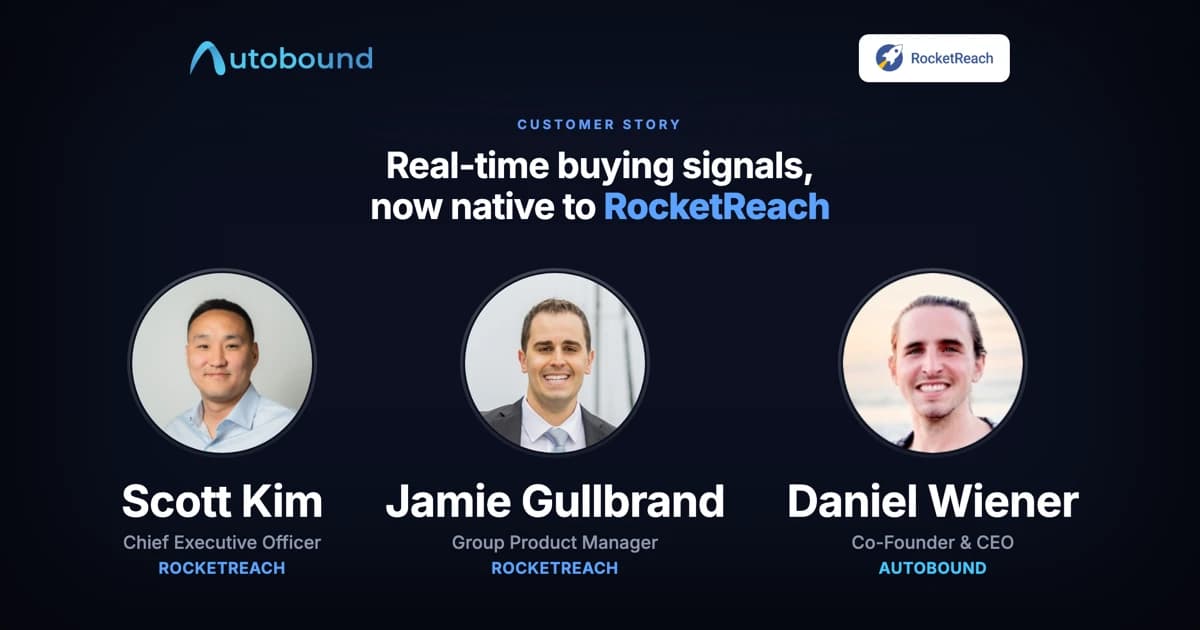
RocketReach: the who, at scale
700M+ professionals, 60M+ companies, and a deliberately lean team behind it
RocketReach, led by CEO Scott Kim, is one of the world's largest contact-data platforms, spanning more than 700 million professionals and 60 million companies. Its promise is simple and hard to beat: find the right person and the right way to reach them, whether that's a verified email, a phone number, or a social profile.
That promise has made RocketReach a daily tool for sales, recruiting, and business development teams who live and die by the quality of their contact data. But great contact data answers part of the outreach question: it tells you who to reach, not when.
RocketReach’s data team has always had a primary focus on coverage and accuracy. And it became clear customers wanted more signaling on when to reach out, with perfect timing.
“This partnership strengthens the foundation of our AI strategy. By combining high-quality contact data, insights from millions of users, and hundreds of signals, we are giving customers greater visibility into what matters most across their target prospects, so they can focus their time on outreach that actually resonates.”
 Scott Kim
Chief Executive Officer, RocketReach
Read the partnership announcement →
Scott Kim
Chief Executive Officer, RocketReach
Read the partnership announcement →
The right contact at the wrong moment goes nowhere
The insight behind this project is one every experienced seller feels in their gut. As Jamie Gullbrand, Group Product Manager at RocketReach, puts it, you can have the right list of contacts, but if you reach out at the wrong moment, it goes nowhere. Knowing who to contact is table stakes; knowing when is the difference between a reply and silence.
RocketReach already understood the value of timing, and customers were asking for signals. Years earlier the team had built a simple in-house system that tracked three event types, funding, mergers and acquisitions, and executive changes, by polling a hand-maintained list of RSS feeds hourly. It worked and proved the value to customers.
Three event types is a thin slice of the moments that matter across 60 million companies. Customers saw the value, and wanted more.
“You can have the right list of contacts, but if you reach out at the wrong moment, it goes nowhere. Signals help our users find the right time to act.”
 Jamie Gullbrand
Group Product Manager, RocketReach
Jamie Gullbrand
Group Product Manager, RocketReach
Why Autobound: coverage they didn't have to maintain
Existing customers were already asking for better timing signals
RocketReach users were asking for richer timing and hiring signals, and because the platform already surfaced a handful of company events, they were primed to use more. Trigger events like funding rounds and leadership changes, plus hiring trends drawn from job postings, became the obvious first signals to bring in from Autobound.
Two benefits made the case immediately. First, breadth: against the three event types RocketReach had hand-built, Autobound surfaces the full range of company moments that signal intent, from funding rounds and leadership changes to new offices, expansions, and product launches. That's not an incremental gain, it's a different order of magnitude in the moments users can act on. Second, maintenance: Autobound owns the pipeline and the upkeep, so when a source changes or breaks, that's Autobound's problem, not a fire drill for RocketReach's data team.
Trust was the gating factor: a signal users don't believe is a signal they stop using. Before shipping, RocketReach ran a manual QA pass across both the event and job-postings data and confirmed it was accurate, which gave the team the confidence to put it in front of users and keep it there.
“RocketReach has built a strong foundation around trusted data and ease of use. Together, we are enabling revenue teams to turn relevant signals into timely, authentic outreach powered by AI.”
 Daniel Wiener
Co-Founder and CEO, Autobound
Daniel Wiener
Co-Founder and CEO, Autobound
From hourly RSS to daily managed delivery
JSONL over GCS, ingested straight into the search backend
Autobound delivers signal data as JSONL files to enterprise destinations like Google Cloud Storage or AWS S3. RocketReach's data team ingests those files directly into the search backend behind Person and Company Search, where the product team surfaces them to users. First delivery to live production took about a month, with most of that time spent coordinating two internal teams: the data team handling ingestion and the product team building the in-app experience.
Early on, Autobound moved delivery cadence from weekly to daily, an upgrade Jamie specifically called out as helpful. Fresher data means users filter on events closer to when they happened, which is the entire point of a timing signal.
The before-and-after is stark. The in-house system covered three event types from a hand-maintained RSS list; Autobound surfaces the full range of company moments and handles all the upkeep. Today Autobound is the primary source behind RocketReach's event signals, with the original in-house feed kept only as a thin supplement.
How it shows up in Search
Pick a signal type, pick a window, see who's in motion
Rather than bolt on a separate signals dashboard, RocketReach embedded Autobound data where users already work: as filters in Person and Company Search. A user picks a signal type, say a funding round or an executive change, pairs it with a time range, and the results narrow to the people or companies that triggered that event in that window. The who and the when collapse into a single query.
That's the whole point. A rep can go from 60 million companies to the specific set that just raised, just changed leadership, or is hiring against a particular trend, and pull the right contacts at those accounts in the same flow, while the moment is still live.
The signal data does double duty: it tells users when to act, and it gives them substance to act with, concrete details from the underlying event and hiring activity that fold straight into a message to make outreach more relevant and personal.

“RocketReach data gives our users the who. Integrating signals data gives our users the when. Great contact data is an essential starting point. Signals make it actionable.”
Jamie Gullbrand
Group Product Manager, RocketReach
What's next: higher frequency, deeper integration, more signal types
From a signal filter to a prioritization engine
The clearest near-term ask is frequency. Daily was a meaningful jump from weekly, and RocketReach would like to push toward hourly or real-time so the platform reflects moments as they happen. The harder, happier problem is choice: with more than 700 signal types in Autobound's catalog, deciding what to integrate next is its own challenge. Given RocketReach's majority-SMB base, website intelligence (around 6M companies monitored across 35 subtypes) and social signals (LinkedIn, Twitter, and YouTube activity at company and contact level) stood out as especially strong fits, alongside technographics, product reviews, and SEC filings for public companies. Autobound's MCP server, which connects every signal type, gives the team a fast way to test new types for list building before committing to a full integration.
Further out, RocketReach plans to weave signals into the prospecting flow itself rather than leave them as a standalone filter: using signals to prioritize which prospects to work, shaping how contacts get recommended, and drafting outreach that incorporates the relevant signal automatically, alongside 5x5 intent data and RocketReach's own job-change signals. The direction is consistent: signals started as a simple search filter and are becoming the layer that decides who the product surfaces and what a user should say.
Explore Related Products
More Signal Intelligence Wins
Informa TechTarget (OEM)
Learn how Informa TechTarget increased user retention by 30% since launching IntentMail powered by Autobound's API.
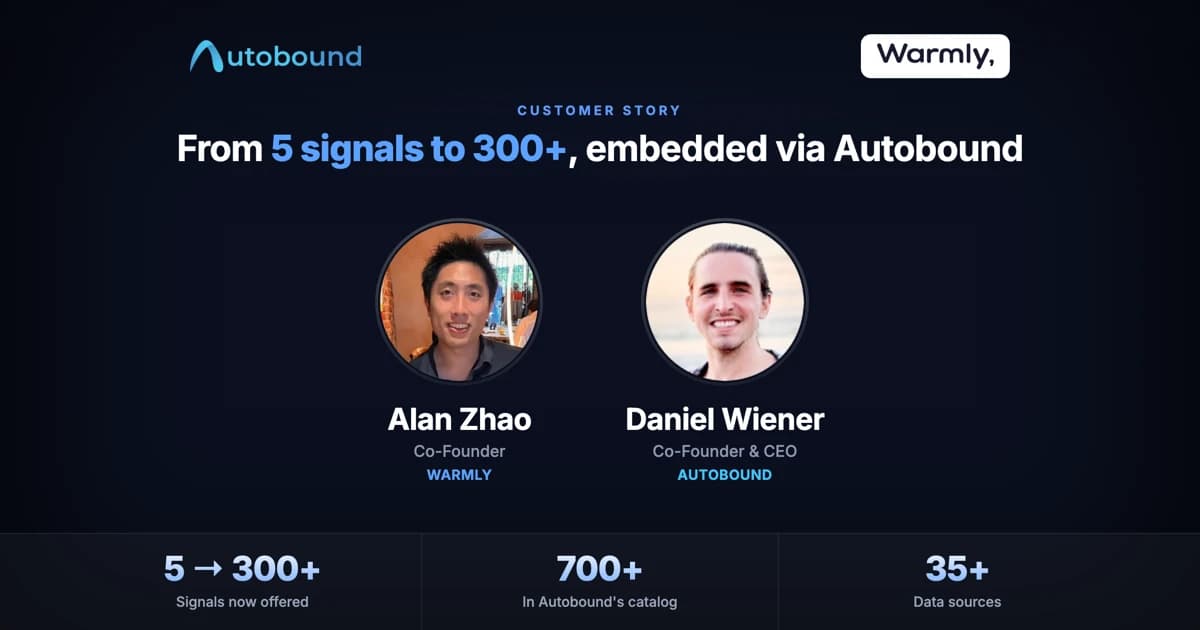
Warmly (OEM)
Learn how Warmly went from 5 signals to 300+ by embedding Autobound's full catalog into its API and MCP server, replacing a 2-year internal build with a single integration.
Oppy
How Oppy saved 18+ months of engineering time by partnering with Autobound for signal data, going from zero to paying customers in under three months.
Get the same signal intelligence
Talk to our team about signal data for your use case.