
Oppy: fixing the moment, not the fit
A sales intelligence platform that turns buying signals into actionable Strategy Cards
Oppy is a sales intelligence platform for B2B tech companies running outbound. It turns real-time market signals into Strategy Cards that tell sales reps which company to reach out to, why they're likely in a buying window right now, and delivers intelligence straight to Slack, CRM, and other tools with no RevOps setup required.
The core insight Oppy validated with their own customers: 80% of replied-but-not-closed conversations fail because of timing, not fit. The ICP is right. The pitch is right. The moment is wrong. Oppy fixes the moment.
As a six-person team burning compute time on the MareNostrum 5 supercomputer to train their proprietary signal synthesis model, Oppy needed to be building intelligence, not infrastructure. They needed a signal data partner who'd already solved the hardest problem in the stack.
The signal layer is genuinely hard to build from scratch
18-24 months and half a million euros just to reach table-stakes quality
Knowing a company raised a round is public information. Knowing that the same company also hired two SDRs and switched their CRM in the same 30-day window, and that this specific combination statistically predicts an open buying window, requires years of signal collection, cleaning, enrichment, and pattern recognition at scale.
Oppy's estimate for building in-house: minimum 18 months, 2 additional senior data engineers at €120-150K each, plus significant infrastructure costs. Total: €400-600K in additional runway just to reach the signal quality and coverage Autobound already had. And that's before building any intelligence on top of it.
Build the intelligence. Buy the signals.
Oppy's moat is synthesis, not data collection
The established players built their moat in raw signal pipes: data at scale. That's not Oppy's moat. Oppy's moat is synthesis. They ingest Autobound's tier-1 signal data and run it through a proprietary signal-weighting architecture trained on the MareNostrum 5 supercomputer.
They don't compete on who has more signals. They compete on who turns signals into finished intelligence: the insight that funding + SDR hiring + a tech stack change, together, mean this account is ready now.
Partnering with Autobound gave Oppy the data foundation in weeks, not years, so they could put all engineering resources into the synthesis layer that none of the established players have built.
“Don't build what someone has already spent years building better than you can in 18 months. Your moat should be in what you do with the data, not the data itself. We made a deliberate choice to partner on signal collection and go deep on signal synthesis. That decision saved us over a year of engineering time and got us to paying customers in under three months.”
20% of contacted accounts from Strategy Cards in month one
Signal convergence is where the intelligence lives
In their first month of alpha, one of Oppy's customers, a 20-person B2B SaaS company, sourced 20% of all accounts she contacted through Oppy-generated Strategy Cards. Each card was built from converging Autobound signals: a company opened a new SDR position, raised a seed round six weeks prior, and added HubSpot to their tech stack in the same window.
Without signal depth at that level, Oppy would be working with single triggers: one alert at a time. The convergence is where the intelligence lives. That's what Autobound's signal data foundation made possible from day one.
The feedback loop: compounding intelligence
Every customer interaction trains the model to predict better
Every time a customer approves or rejects a Strategy Card, and every time they report whether a deal closed, that signal trains Oppy's model. They're building compounding intelligence: the more customers use Oppy, the better it predicts which signal combinations mean "buy now" for each specific ICP.
Autobound's signal data foundation lets Oppy focus their MareNostrum 5 compute on learning those patterns rather than collecting raw events. The result: an intelligence layer that gets smarter with every interaction, built on top of signals that are already best-in-class.
“Oppy's intelligence is only as good as the signals underneath it. Autobound gives us the data depth to tell sales teams not just who might buy, but who is ready to buy right now.”
Frequently asked questions
What is Oppy and what does it do?
Oppy is a sales intelligence platform for B2B tech companies running outbound. It turns real-time market signals into Strategy Cards that tell sales reps which company to reach out to, why they're likely in a buying window, and delivers intelligence straight to Slack, CRM, and other tools — with no RevOps setup required.
Why did Oppy choose to partner with Autobound instead of building their own signal layer?
Building the signal data infrastructure in-house would have required 18-24 months, 2 additional senior data engineers (€120-150K each), and €400-600K in additional runway. Oppy chose to focus engineering resources on their proprietary signal synthesis layer (trained on MareNostrum 5) rather than data collection.
What results did Oppy achieve with Autobound's signal data?
In their first month of alpha, one customer sourced 20% of all contacted accounts through Oppy-generated Strategy Cards built on converging Autobound signals (funding + SDR hiring + tech stack changes in the same window).
How does Oppy use Autobound's signals differently than other customers?
Oppy doesn't just surface individual signals — they run Autobound's data through a proprietary signal-weighting architecture trained on the MareNostrum 5 supercomputer to identify convergence patterns that predict buying windows. They compete on synthesis, not raw signal volume.
How long did it take Oppy to integrate Autobound's signal data?
Oppy gained access to Autobound's signal data foundation in weeks rather than the 18+ months it would have taken to build, allowing them to reach paying customers in under three months total.
Explore Related Products
More Signal Intelligence Wins
RocketReach
Learn how RocketReach added a timing layer to its 700M+ contact database by embedding Autobound's buying signals (funding rounds, leadership changes, hiring activity and more) into Person and Company Search.
Informa TechTarget (OEM)
Learn how Informa TechTarget increased user retention by 30% since launching IntentMail powered by Autobound's API.
Warmly (OEM)
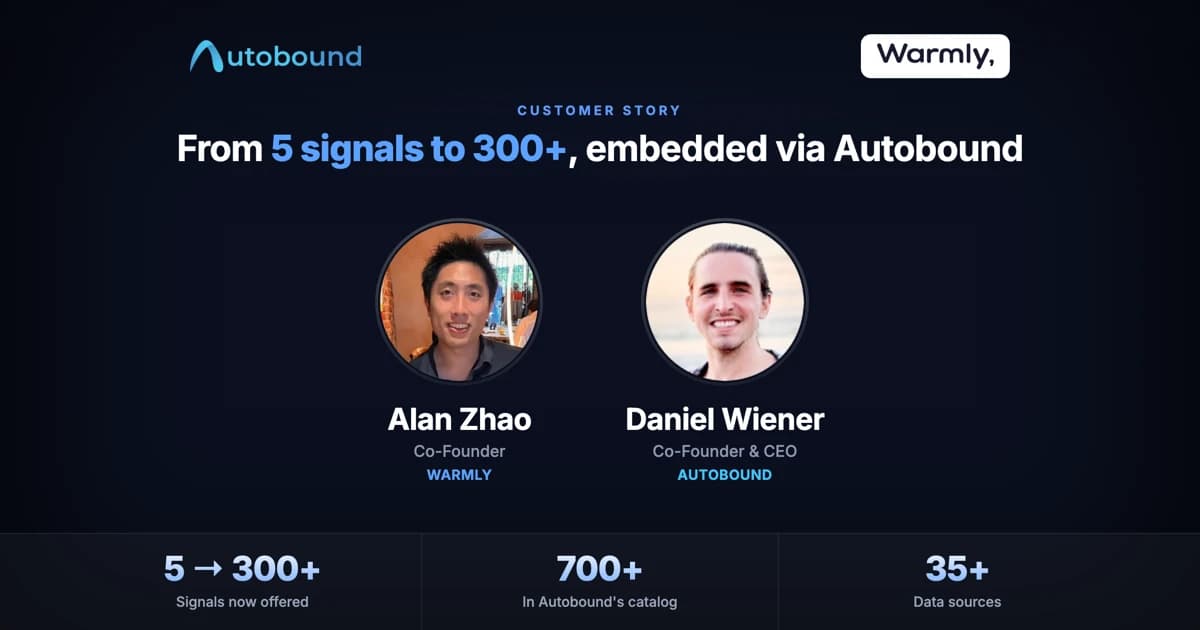
Learn how Warmly went from 5 signals to 300+ by embedding Autobound's full catalog into its API and MCP server, replacing a 2-year internal build with a single integration.
Get the same signal intelligence
Talk to our team about signal data for your use case.