
Neural rendering changes the graphics equation
Article excerpt
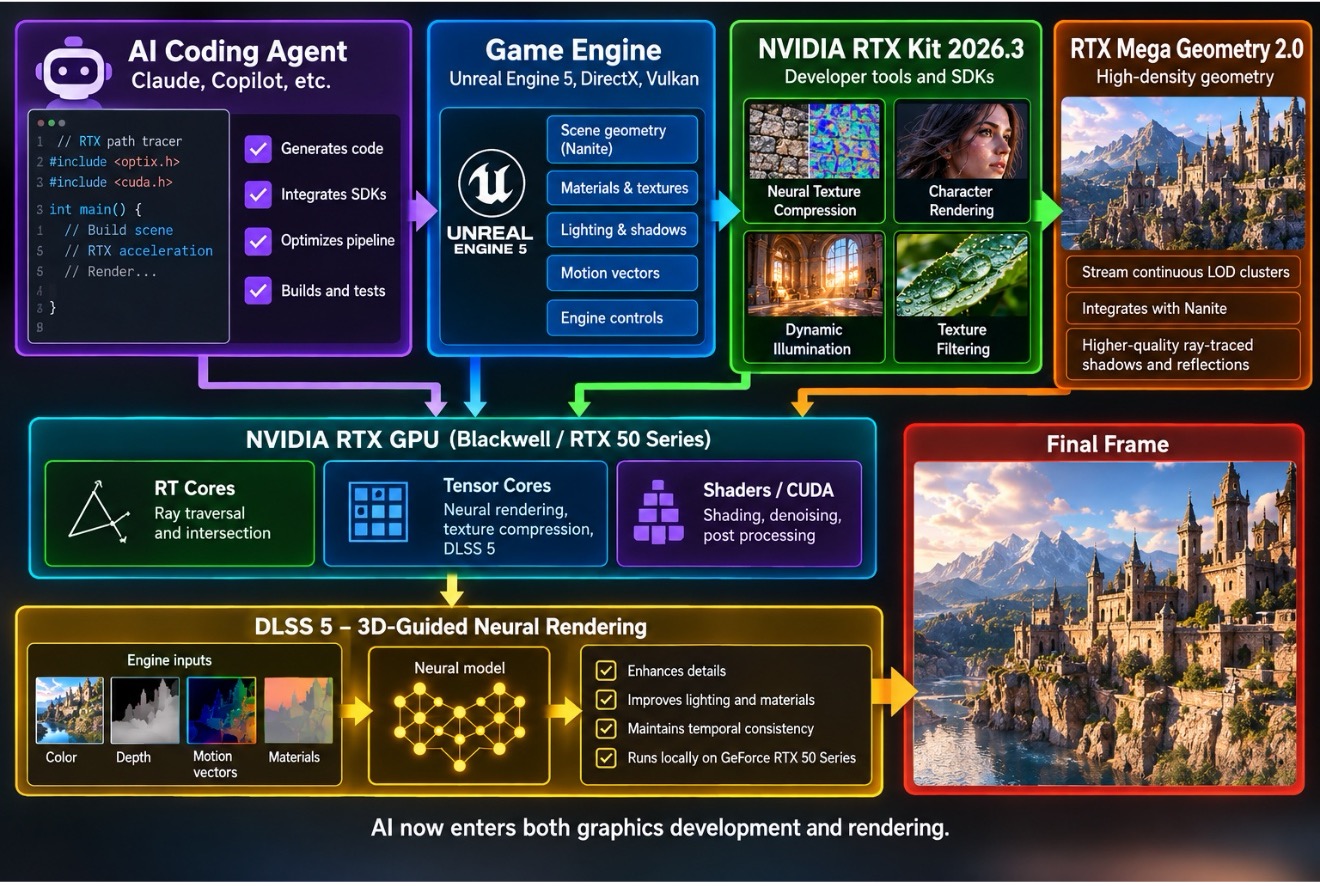
Graphics technology is entering another period of architectural change. Nvidia is expanding neural rendering across its RTX pipeline, while AMD is developing new approaches to geometry processing, ray tracing, and AI-assisted image generation. Independent programmers have also demonstrated unofficial Nvidia DLSS implementations on Radeon GPUs. Meanwhile, AI coding agents are helping developers assemble sophisticated rendering software. These developments promise better visual quality, reduced memory requirements, and faster software development, with important implications for game engines, silicon design, and professional visualization. The graphics industry is changing how GPUs produce images. Conventional rasterization, ray tracing, neural networks, and geometry optimization now share the rendering workload. Nvidia and AMD are developing techniques that reduce processing overhead, improve image quality, and increase the amount of scene detail that existing hardware can manage. Nvidia’s RTX Kit 2026.3 extends neural processing into graphics workflows through RTX Mega Geometry 2.0, Neural Texture Compression, Neural Shading, and DLSS 5. The technologies address geometry management, texture storage, illumination, image reconstruction, and shader execution. Figure 1. AI now refines pixels and writes the code behind them. (Source: JPR) Neural Texture Compression 0.10 beta...
Keep reading with a free account
The rest of this article, and every signal for AMD, is in your free account.
Extracted from this sentence
The supplied material also describes FSR Diamond, sometimes identified as FSR 5, as a future neural rendering technology.