
ConfluentLaunch

Confluent moves Schema IDs to Kafka headers to simplify schema governance.
What happened

Confluent Enterprise launches approach to managing schema metadata in Apache Kafka.

Source

Article excerpt

Highlighted: the sentence this signal was extracted from

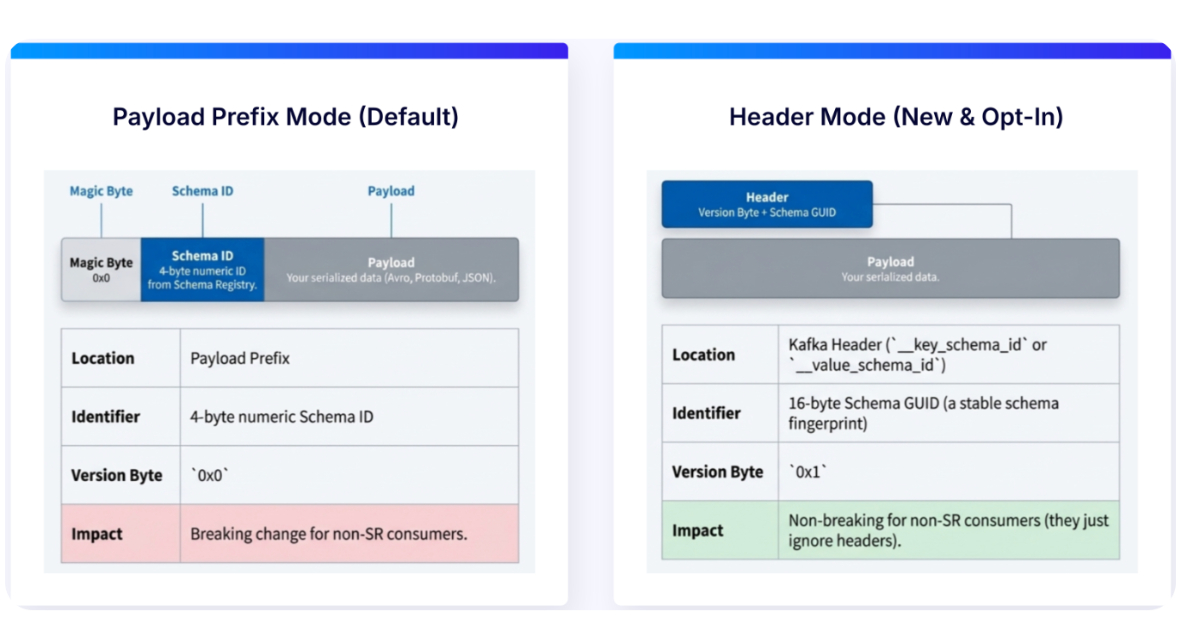
Confluent moves Schema IDs to Kafka headers to simplify schema governance. Write for infoq. Feed your curiosity. Help 550k+ global senior developers each month stay ahead. Get in touch Confluent has introduced a new approach to managing schema metadata in Apache Kafka by enabling schema IDs to be stored in message headers rather than in the payload. The update is designed to simplify data governance and enable teams to adopt schema validation without changing existing event formats. The feature builds on Kafka's native header support and integrates with Confluent Schema Registry, which is widely used by organizations managing event-driven architectures across microservices, analytics pipelines, and data platforms. In traditional Kafka deployments using Confluent's wire format, schema IDs are embedded directly in the message payload. This ensures consumers can correctly deserialize events, but it tightly couples schema metadata with the data itself. Over time, this coupling complicates schema evolution, especially in environments where multiple teams and systems consume the same event streams. It also increases coordination overhead when schema changes are introduced across producers and consumers. With the new approach, schema identifiers are stored in Kafka record headers while the payload remains unchanged. Consumers retrieve the schema from the schema registry at...

Keep reading with a free account

The rest of this article, and every signal for Confluent, is in your free account.

Extracted by Autobound

From the Signal API record
Event
Launch

What this signalsA launch often needs new go-to-market and support spend.

The full record

From the Signal API record

Details

Product
approach to managing schema metadata in Apache Kafka
Category
Launches

Extraction

Confidence
67%
Detected
May 1, 2026
signal_type
news
signal_subtype
launches

Use this data

Get every launch signal for Confluent and the companies you sell to, in the tools you already use.

  1. Ask Claude about it

    Connect Autobound to Claude, Claude Code or Cursor with MCP. Then ask: “What changed at Confluent this week?”

  2. Send it to your own tools

    The Signal API returns launch signals for any list of companies as JSON, for your CRM, warehouse or app.

  3. Try it free

    Sign up and spend your free credits on the companies you sell to.

    Start Free1,000 free credits

The API returns more than this page shows

This page shows a preview. The full news record in the Signal API and MCP can also have these 8 fields. Some fields are empty for some signals.

Company

  • linkedin_urlValue in the API
  • industriesValue in the API
  • employee_count_lowValue in the API
  • employee_count_highValue in the API
  • revenueValue in the API
  • descriptionValue in the API

Signal

  • signal_nameValue in the API
  • associationValue in the API
Show the full JSONThe record on this page and the API request

GET /v1/signals/3b16868f-bb17-4d27-890b-89cf4e499bcf returns this record as JSON. POST /v1/companies/enrich returns every signal for confluent.io.

{
  "signal_id": "3b16868f-bb17-4d27-890b-89cf4e499bcf",
  "signal_type": "news",
  "signal_subtype": "launches",
  "detected_at": "2026-05-01T00:00:00+00:00",
  "company": {
    "name": "Confluent",
    "domain": "confluent.io"
  },
  "data": {
    "url": "https://www.infoq.com/news/2026/05/confluent-kafka-header-schema-id",
    "title": "Confluent moves Schema IDs to Kafka headers to simplify schema governance.",
    "excerpt": "Confluent moves Schema IDs to Kafka headers to simplify schema governance.\n\nWrite for infoq.\n\nFeed your curiosity. Help 550k+ global senior developers each month stay ahead. Get in touch\n\nConfluent has introduced a new approach to managing schema metadata in Apache Kafka by enabling schema IDs to be stored in message headers rather than in the payload. The update is designed to simplify data governance and enable teams to adopt schema validation without changing existing event formats. The feature builds on Kafka's native header support and integrates with Confluent Schema Registry, which is widely used by organizations managing event-driven architectures across microservices, analytics pipelines, and data platforms.\n\nIn traditional Kafka deployments using Confluent's wire format, schema IDs are embedded directly in the message payload. This ensures consumers can correctly deserialize events, but it tightly couples schema metadata with the data itself. Over time, this coupling complicates schema evolution, especially in environments where multiple teams and systems consume the same event streams. It also increases coordination overhead when schema changes are introduced across producers and consumers.\n\nWith the new approach, schema identifiers are stored in Kafka record headers while the payload remains unchanged. Consumers retrieve the schema from the schema registry at...",
    "product": "approach to managing schema metadata in Apache Kafka",
    "summary": "Confluent Enterprise launches approach to managing schema metadata in Apache Kafka.",
    "category": "launches",
    "found_at": "2026-05-01T00:00:00Z",
    "planning": false,
    "image_url": "https://res.infoq.com/news/2026/05/confluent-kafka-header-schema-id/en/headerimage/generatedHeaderImage-1776736992912.jpg",
    "confidence": 0.6673,
    "product_data": {
      "full_text": "approach to managing schema metadata in Apache Kafka",
      "fuzzy_match": true
    },
    "published_at": "2026-05-01T00:00:00Z",
    "article_sentence": "Confluent has introduced a new approach to managing schema metadata in Apache Kafka by enabling schema IDs to be stored in message headers rather than in the payload."
  }
}

Long text fields are shortened on this page.

Looking up one signal by its id is free. Enrich costs 2 credits per signal returned; a call with no results is free.