
Huawei unveils new UnifiedBus computing architecture for SuperPoDs and clusters
Article excerpt
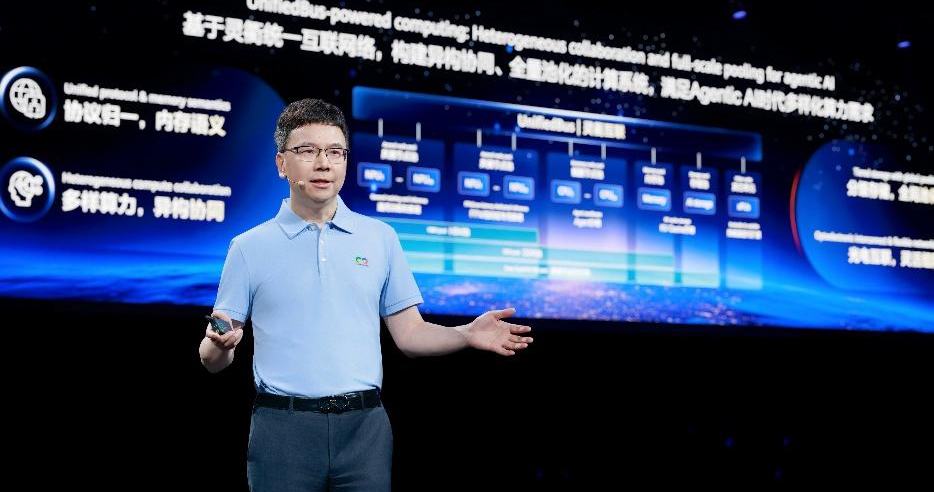
Huawei has released a new computing architecture that utilizes UnifiedBus to support cluster and SuperPoD interconnect, in order to address booming compute demand In a recent keynote speech on computing architecture innovation at HUAWEI CONNECT 2026, Yang Chaobin, Huawei's executive director of the board and CEO of the ICT Business Group, unveiled new details about the UnifiedBus interconnect architecture. He also announced a series of computing products Huawei has recently built based on this architecture, and explained how the company has collaborated with open-source communities to enable application innovation by customers, partners, and developers. In a traditional computing architecture, resource utilization declines as a cluster scales. As little as 20% of a 100,000-NPU cluster's computing capacity is actually utilized by models, with a vast amount of compute sitting idle during data communications. A 10 trillion-parameter model, which requires massive amounts of intermediate data to train, far exceeds the capacity of the memory on a single accelerator under traditional architectures. Furthermore, AI agents can have hundreds of interactions per hour with AI models, which means computing systems need to be able to flexibly utilize changing amounts of central processing units (CPUs) and neural processing units (NPUs). The resulting interactions between these processors...
Keep reading with a free account
The rest of this article, and every signal for Huawei, is in your free account.
Extracted from this sentence
Yang also launched Huawei's UnifiedBus-powered agentic AI SuperCluster, which is comprised of TaiShan 950 and Atlas 960 SuperPoDs, OceanStor M900 memory storage, and a Xinghe UBG switch.