
Unilever Restructures: $44.8 Billion Food Merger Targets Valuation
Article excerpt
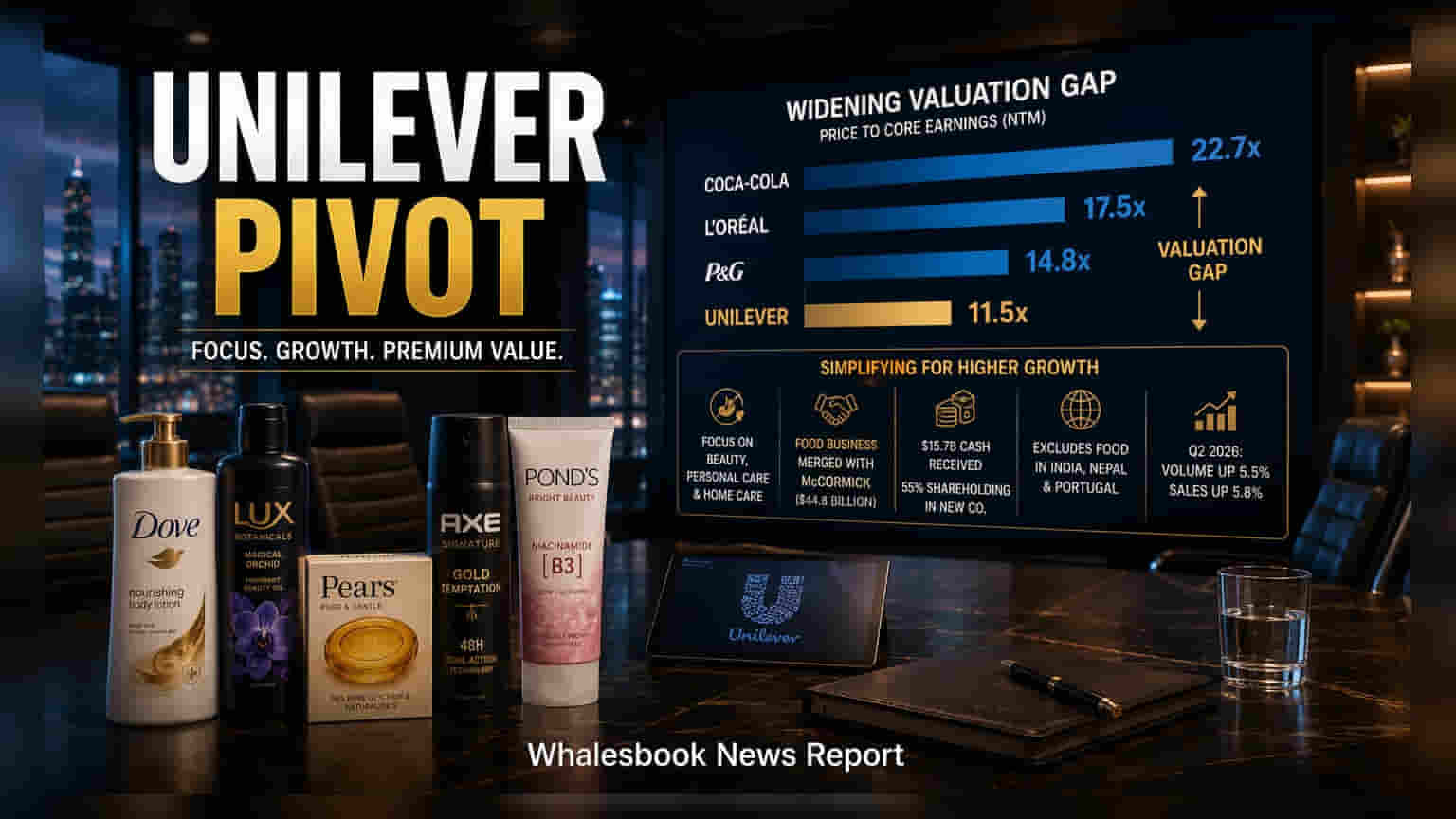
Unilever is merging its food division with McCormick & Company in a $44.8 billion deal to close its valuation gap with pure-play rivals. While the company reported strong volume growth in Q2 2026, investors are watching for sustained performance over several quarters before they fully back the strategy. Unilever is making a significant shift to streamline its business, moving away from being a sprawling conglomerate to focus on high-growth areas like beauty, personal care, and home care. By merging its global food division with McCormick & Company in a transaction valued at $44.8 billion, the company aims to simplify its operations and improve how it is valued by the stock market. Market data highlights the reason for this move. Unilever currently trades at approximately 11.5 times its core earnings. This valuation is notably lower than competitors that focus on specific categories, such as Procter & Gamble at 14.8 times, L'Oreal at 17.5 times, and Coca-Cola at 22.7 times. Analysts often call this difference a conglomerate discount, where the market applies a lower valuation to large, diversified companies because they are perceived as more complex and less efficient than focused businesses. Management hopes that by offloading the food division, Unilever will eventually command a premium closer to these rivals. The merger, which was announced in March 2026, uses a specific...
Keep reading with a free account
The rest of this article, and every signal for Unilever, is in your free account.
Extracted from this sentence
In the second quarter of 2026, Unilever reported its highest volume growth in over a decade, with underlying sales rising 5.8% and volume up 5.5%.